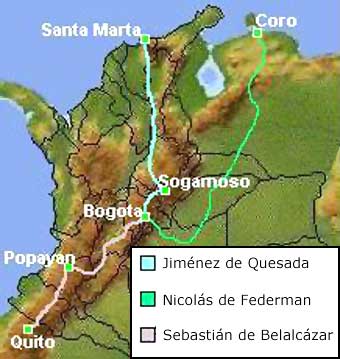
 The most famous expedition in search of El Dorado was that of Francisco de Orellana in 1541, although there were other attempts before it. At first, the explorers sought El Dorado in the Andes, near Colombia. Sebastian de Belalcazar, a Spanish conquistador who traveled with Christopher Columbus and Francisco Pizarro, sought El Dorado in south-western Colombia in 1535. Nicholas Federmann, German explorer and chronicler who participated in the Spanish conquest of Venezuela and Colombia, also led an expedition to find El Dorado in 1535. The Spanish conquistador Gonzalo Jimenez de Quesada sailed in search of El Dorado in 1536. Having defeated the Muiscas and have established the capital Bogota as the New Kingdom of Granada, Quesada realized that Belalcázar Federmann and had also claimed the same land in a peaceful gathering held in Bosa, convinced them return to Spain in 1539 and resolve the issue.
As the three legal battles entablaban New Granada, men continued the search. In 1541 Gonzalo Pizarro and Francisco de Orellana out in search of El Dorado and end in a disastrous trip down the Amazon. After being divided into two groups, Pizarro and his men returned to Quito, while Orellana continued the journey, discovering and naming the Amazon River.
In 1541 the Spanish explorer, born in Germany, Philip of Utre, launched a fruitless search of El Dorado along the Amazon in Omagua territory. Found a densely populated, but no golden kingdom.
 Walter Raleigh was the first explorer to undertake the search. Raleigh departed for Spanish Guiana, then called Nueva Andalucía (now Venezuela), which was named in 1595 as "Guiana". He sailed along the Orinoco River where he found some gold objects, but none of the dimensions of the legend. On his return to London he published a book about his journey titled The Discovery of Guiana, where she was promoting the exploration of United Dorado. In 1617 organized the second expedition to Guiana, took possession of part of the region on behalf of England, but after destroying some Spanish settlements, was arrested again at the request of Spain. On his return to London was sentenced to death and then beheaded at Whitehall in 1618.
In 1987 was published in a local newspaper Folha de Boa Vista Roraima State (Brazil) which could mean, if verified, an exceptional discovery made by Roland Stevenson, Chilean based in the city of Manaus. Realized an Inca trail from Ecuador to the mountains of the Guianas with stone drums in its path. Also found remnants of clothing and even Inca stone carvings with Andean. Also speculated that the name "Guyana" could come from the Inca Huayna Capac, and that it is similar, and said that some ethnic groups speak a language related to the Quechua language, 1 and the appearance of some representatives of the ethnic Yanomami was very similar to the Andean people.

No hay comentarios:
Publicar un comentario