-The golden legend becomes myth utopian and would be a great fortune to anyone who came across this place but it is a rather unrealistic or at least until proven otherwise
- This story makes clear the limits to which we humans when we are blinded by ambition, even leads to death
-from another perspective this story leaves a great legacy of culture in our country and enhances the bathing Guatavita sector in history and tradition
jueves, 8 de noviembre de 2012

Introduction
INTRODUCTION
WE REALIZE
THIS WORK TO GIVE HIM TO KNOW OUR PARTNERS ABOUT WHOM THERE TALKS EACH OTHER
THE FAMOUS LEGEND OF THE GILDING, WHICH TURNS OUT TO BE, VERY INTERESTING IF WE
INVESTIGATE AND READ A LITTLE ON THIS.
PRINCIPAL OBJECTIVE
TO ANALYZE
THE DIFFERENT MYSTERIES TOLD DURING THE HISTORY ON THE LEGEND OF THE GILDING.
SPECIFIC
OBJECTIVES
- TO
INVESTIGATE ON THE LEGEND OF THE GILDING
- TO
EXPLAIN IN BRIEF WORDS THE LEGEND OF THE GILDING
- TO
ANNOUNCE BASIC ASPECTS ON THE LEGEND OF THE GILDING.
lunes, 29 de octubre de 2012
LEGEND OR MYTH THE DORADO
This Colombian legend is one of the best known for its connection with the conquest of America. The Spanish conquerors sought a country famous for its legendary untold riches (El Dorado). The origin of this belief lies in the consecration ceremony of the new Zipas.
In the beautiful country of Muiscas, long ago, everything was ready for an event: the coronation of the new Zipa, governor and chieftain.
 The Guatavita, natural scenery and sacred event looked calm and crystalline surface like a giant emerald, set among beautiful hills. The slopes, with dense ferns, golden buttons showed Chisacá, chusques twisted as triumphal arches, sietecueros and fragrant berries. The digital, like a beautiful bunch of bells, purple-tinged landscape, dandelion, which fragile bubble, the wind tossed their tiny parachutes to perpetuate the miracle of its preservation and abutilones of bright red and yellow concert amounted to natural beauty, the tiny, iridescent hummingbird, its permanent guest.
Great excitement reigned in Bacatá Zipa housing, the entire population would attend the unique event in jubilant procession to the sacred lake wearing shiny gold jewelry, emeralds, artistically exquisite pottery and woven blankets, to offer to Chibchacum, their supreme god, the goddess of the waters, and his new sovereign Badini.
 The women had prepared in advance abundant meal of golden ears and wine ferment extracted from corn with which celebrated all the major events of his life. Everything would be transported in vessels of different shapes and sizes, with patience and dedication made by potters Ráquira, Tinjacá and Tocancipá and also woven palm baskets.
Finally, the big day arrived. The young heir with his entourage, composed of priests, warriors and nobility, led the procession. Serene and majestic, her body showed strong harmonious proportions for war, his tan skin had a certain pallor, a result of rigorous fast she had undertaken to purify your body and soul and to implore the gods and justice, goodness and wisdom to govern his people.
 They marched to the sound of rhythmic drums, the fotutos and snails. Slowly, they went away from the hills and surrounded by the Zipas, to approximate the Guatavita splendid. There, with joyous songs, the crowd gathered to witness the magnificent spectacle.
The priest, dressed in sober robes and multicolored feathers, silenced the population with an energetic movement of his outstretched arms. Coppery skin and lean meats for the prolonged fasting, the priest was feared and revered by the people was the mediator between men and gods, who performed the offerings and prayers and who cured the ills of the body with their prayers and support magical plant.
The future Zipa was stripped of his clothes and his body smeared with turpentine, sticky substance, to be set in gold dust that covered them constantly.

Not a sound was heard, was that the solemnity of the moment, you only hear the croaking of frogs, animals sacred to them, the chirping of birds and the fast running of the deer.
The anointed seemed a golden statue: his splendid body carefully covered with the noble metal, reflections dismissed when touched by the sun's rays. When he had finished coating, leading up to the court on a large oval raft, made entirely in gold Guatavita goldsmiths.
The raft slid gently into the center of the lagoon. That's when, after invoking the goddess of waters and protecting gods, the heir plunged into the depths, spent a few seconds in which only saw water circles where it had sunk, all the people gasped , time seemed to stop, finally emerged triumphant and solemn the new monarch, the ritual bath, he consecrated him as chief.
 Cheers and chants accompanied his appearance and one by one, the subjects threw their offerings to the lagoon: gold figures, bracelets, crowns, necklaces, pins, chest, hollow vessels with human forms, full of emeralds, pitchers and jugs mud. The chief, in turn, together with his entourage, made generous offers of the same materials, but more of them.
The raft returned to shore amid the general clamor. They now had a new boss, who should rule according to the wise rules and legislator Nemequene legendary predecessor, based on love and skill at work and handicrafts, in the courage and honor during the war, on honesty, justice and discipline.
Began racing games and competitions, the winner was rewarded with beautiful blankets. They sang and danced for three days, which were devoted to the celebration. The sounds of drums and whistles echoed in the mountains and hundreds of Indians continued the pace in calm and rhythmic dances, or frantic and crazy.
 After a day of festivities, drink and food plentiful, the people returned to their daily activities: farmers to continue watching and tending their crops; gold artisans, to work in gold, the potters, the making pots and vases, after searching the mud right in special streaks, others to exploit the salt mines and emeralds, and most trade because it was their main activity. Women caring for children, to reap the harvest, to cook, to spin and weave.
Thus, in this order and the days elapse placidity, until war, disease or old age, deprived of their monarch and was again required Dorado ceremony to anoint a new chief. This should continue to govern with prudence and wisdom of the village green and fertile country, surrounded by lush vegetation and crystal clear streams.
Origin of the legend
 began in 1530 in the Andes of what today is Colombia, where conquistador Gonzalo Jimenez de Quesada first found the Muisca, a company located in what is now known as the Altiplano Cundiboyacense. The story of Muisca rituals was brought to Quito by Sebastian de Belalcazar men, mixed with other rumors, there was formed the legend of El Dorado, "The Golden Man," "El Indio Dorado," "The Golden King". Imagined as a place, El Dorado became a kingdom, an empire, the city of this legendary place.
[edit] Indian gold Ceremony
Indian gold Ceremony

In 1636 Juan Rodriguez Freyle wrote a version, addressed to his friend Don Juan, the chief or ruler of Guatavita:
"... At that Guatavita became a great raft of reeds, and most showy aderezábanla that could ... At this time the entire lagoon was crowned Indians and turned the entire circumference, all Indians and Indian gold crowned , feathers and stripped the heir chagualas ... (...) and smeared with a sticky league, and sprayed everything with gold dust, so that was all covered with this metal. Metíanlo on the raft, which was stopped, and put his feet a great heap of gold and emeralds to offer to his god. They went with him in the boat four caciques, the most major ones adorned with feathers, crowns, bracelets, earrings and gold chagualas, and naked ... to the Indian gold casting his offer all the gold and emeralds carrying feet amid the lagoon, then the other chiefs seguíanse accompanying him. After the ceremony the flags flapped ... And from the raft to land the screams began ... With dances dances and dances his way. With the ceremony which was recognized by the newly elected lord and prince. "
There are other gaps in the department of Cundinamarca in which this ritual is practiced and where they found pieces of gold, exhibited today in the Gold Museum in Bogota. One of them, the Muisca Raft of Pasca, the rite of El Dorado in a beautiful golden statuette found in the countryside near the village of Pasca, Cundinamarca.
Muisca population and their treasures quickly fell into the hands of the conquerors. To take stock of the new land obtained, the Spanish soon realized that, despite the amount of gold in the hands of the Indians had no golden cities, nor even rich mines, since the Muisca gold obtained through trade with neighboring countries. But at the same time the Spanish began to hear stories of El Dorado from captured Indians, and the rites that took place in Guatavita.
The Guatavita today has a big ditch in its side, evidence of attempts that were made in 1580 to drain the pond.
Expeditions
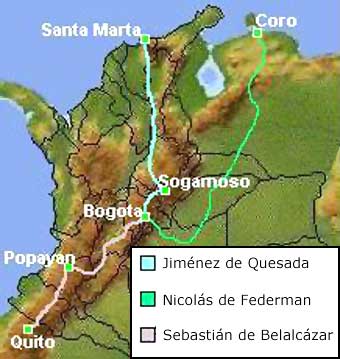 The most famous expedition in search of El Dorado was that of Francisco de Orellana in 1541, although there were other attempts before it. At first, the explorers sought El Dorado in the Andes, near Colombia. Sebastian de Belalcazar, a Spanish conquistador who traveled with Christopher Columbus and Francisco Pizarro, sought El Dorado in south-western Colombia in 1535. Nicholas Federmann, German explorer and chronicler who participated in the Spanish conquest of Venezuela and Colombia, also led an expedition to find El Dorado in 1535. The Spanish conquistador Gonzalo Jimenez de Quesada sailed in search of El Dorado in 1536. Having defeated the Muiscas and have established the capital Bogota as the New Kingdom of Granada, Quesada realized that Belalcázar Federmann and had also claimed the same land in a peaceful gathering held in Bosa, convinced them return to Spain in 1539 and resolve the issue.
As the three legal battles entablaban New Granada, men continued the search. In 1541 Gonzalo Pizarro and Francisco de Orellana out in search of El Dorado and end in a disastrous trip down the Amazon. After being divided into two groups, Pizarro and his men returned to Quito, while Orellana continued the journey, discovering and naming the Amazon River.
In 1541 the Spanish explorer, born in Germany, Philip of Utre, launched a fruitless search of El Dorado along the Amazon in Omagua territory. Found a densely populated, but no golden kingdom.
 Walter Raleigh was the first explorer to undertake the search. Raleigh departed for Spanish Guiana, then called Nueva Andalucía (now Venezuela), which was named in 1595 as "Guiana". He sailed along the Orinoco River where he found some gold objects, but none of the dimensions of the legend. On his return to London he published a book about his journey titled The Discovery of Guiana, where she was promoting the exploration of United Dorado. In 1617 organized the second expedition to Guiana, took possession of part of the region on behalf of England, but after destroying some Spanish settlements, was arrested again at the request of Spain. On his return to London was sentenced to death and then beheaded at Whitehall in 1618.
In 1987 was published in a local newspaper Folha de Boa Vista Roraima State (Brazil) which could mean, if verified, an exceptional discovery made by Roland Stevenson, Chilean based in the city of Manaus. Realized an Inca trail from Ecuador to the mountains of the Guianas with stone drums in its path. Also found remnants of clothing and even Inca stone carvings with Andean. Also speculated that the name "Guyana" could come from the Inca Huayna Capac, and that it is similar, and said that some ethnic groups speak a language related to the Quechua language, 1 and the appearance of some representatives of the ethnic Yanomami was very similar to the Andean people.
Suscribirse a:
Entradas (Atom)